How Upvotes Help Your Product Get More Exposure on LaunchVault
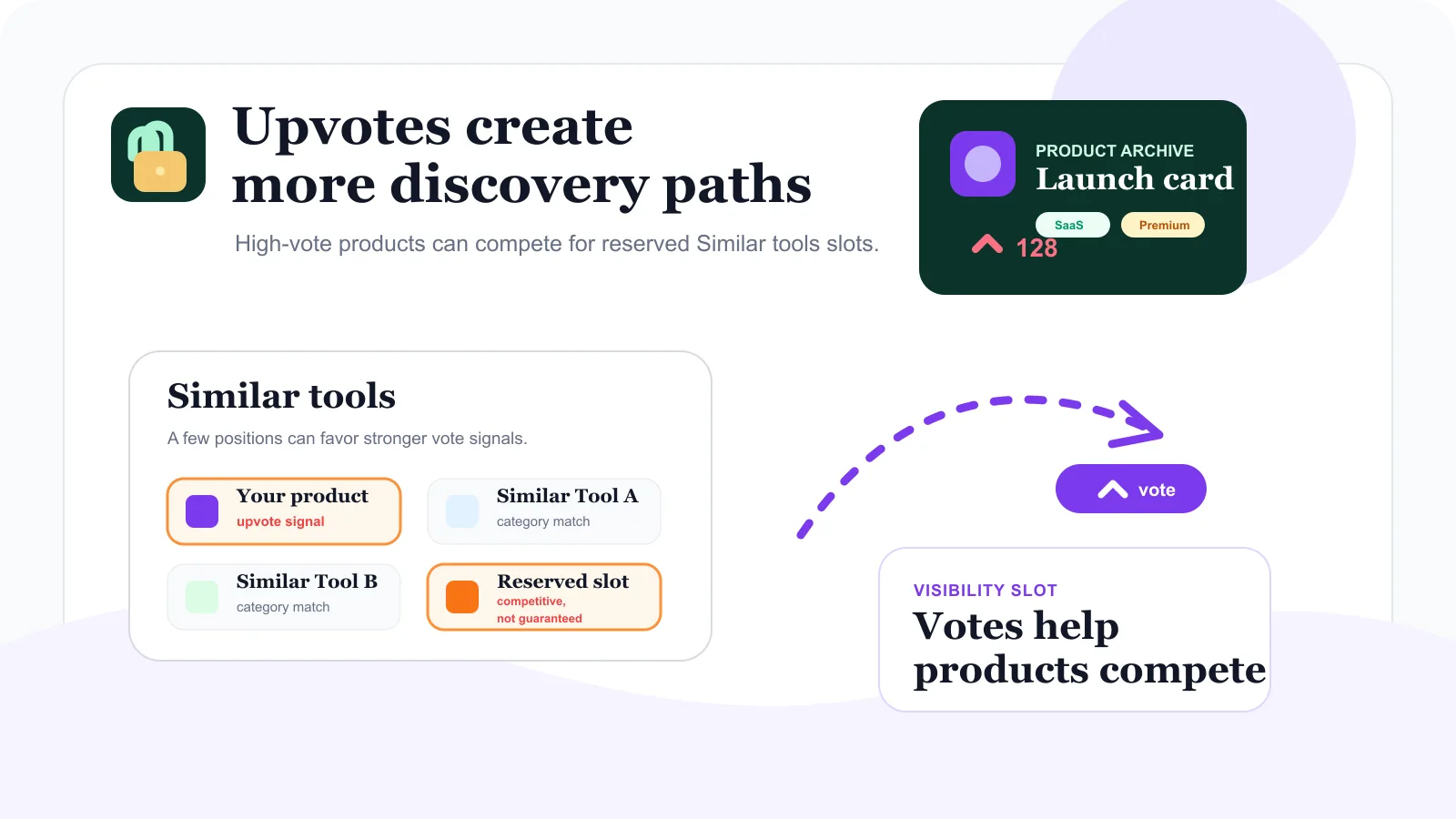
High-upvote products on LaunchVault can compete for reserved visibility slots in the Similar tools area on related product pages.
Launching is not only about the traffic you get on launch day.
On LaunchVault, every upvote also becomes a signal that can help your product earn more visibility across the site. A strong launch can put your product in front of people who are browsing related categories, comparing alternatives, or reading another product's detail page.
One of the most useful places this can happen is the Similar tools module.
The short version
When a visitor opens a product detail page, LaunchVault can show a set of related products under Similar tools. These cards link to other product pages in the same or related category.
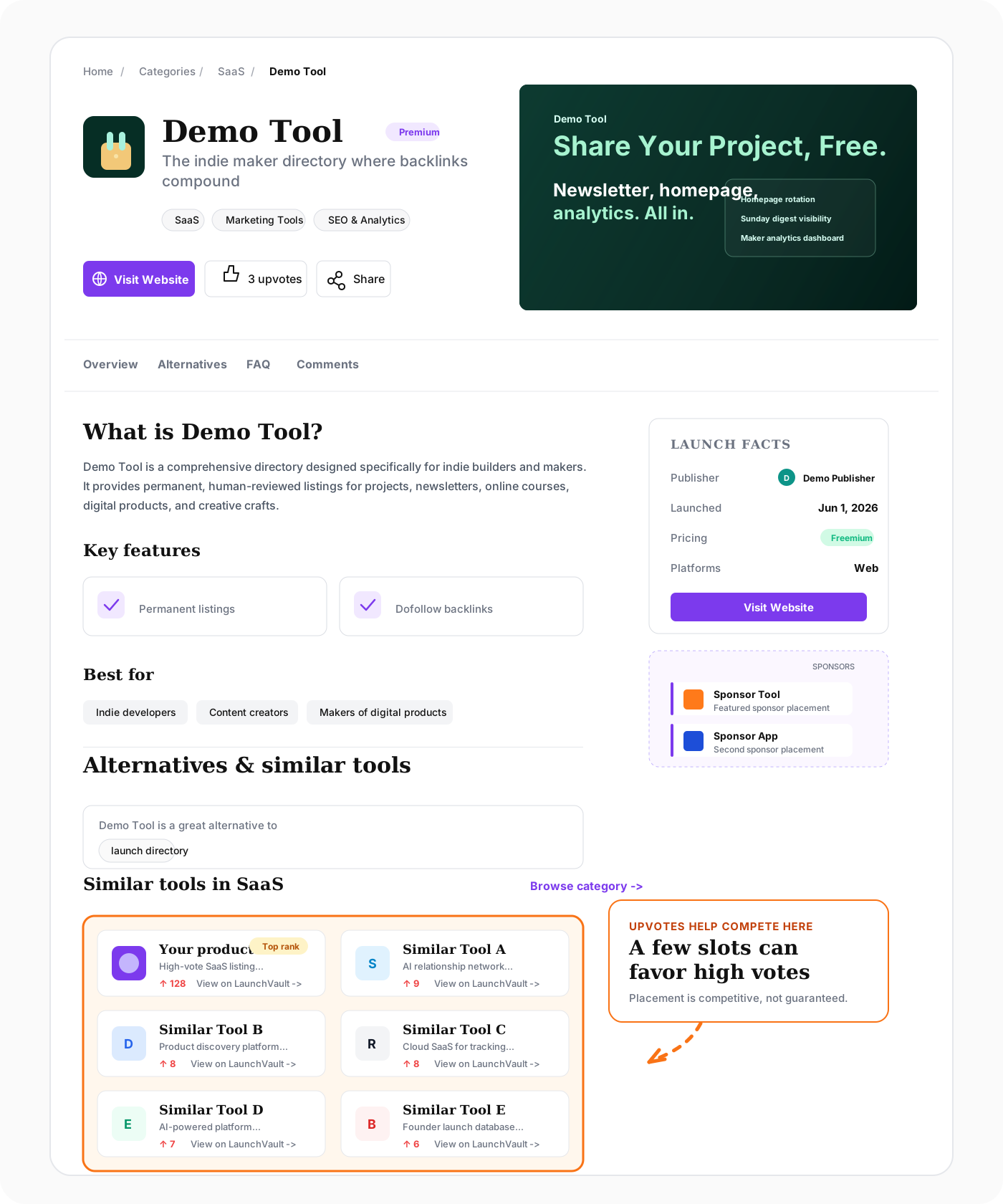
Part of that module is reserved for high-upvote products. In a six-card Similar tools block, for example, only a few positions may be influenced by vote strength. That means a product with more votes has a better chance of competing for those limited slots, but placement is not guaranteed.
In plain English:
- More upvotes can help your product compete for vote-sensitive Similar tools slots.
- Those slots can create more opportunities to appear on related product pages.
- More opportunities can mean more clicks, profile visits, and potential users over time.
It is not a magic traffic switch. Similar tools has limited space, and only part of the module is influenced by upvote strength. Your product still needs to be launched, relevant to the category, and strong enough to compete for those limited slots.
Where your product can appear
Here is a simplified mock of a product detail page. The highlighted area shows where high-vote products can compete for reserved positions inside the Similar tools module on another product's page.
Think of it as a second shelf.
Your own product page is the first shelf: people land there directly from your launch, category pages, search, or external links. The Similar tools module is another shelf: people who are already looking at a related product can discover yours without searching for it by name.
That is valuable because the visitor intent is already warm. They are not randomly browsing the internet. They are already comparing tools in your space.
Why votes matter after launch day
Many founders treat votes as a one-day scoreboard. That is too narrow.
Votes are useful because they create trust. When someone sees two similar tools, the one with stronger community activity often gets more attention. It feels more alive, more validated, and more worth checking.
On LaunchVault, votes also help with internal discovery. Similar tools are drawn from launched products in the same or related category. Within that module, a limited number of positions can favor high-upvote products, so earning more votes can make your product more competitive for those spots.
This creates a simple flywheel:
- You launch and bring your audience.
- Your audience upvotes your product.
- Your product becomes more competitive inside its category.
- Your product becomes more competitive for the vote-sensitive slots in Similar tools.
- Related product pages can create more discovery opportunities after the launch window.
The best part is that this exposure is contextual. A design tool appears near other design tools. An analytics product appears near other analytics products. A developer tool appears near related developer tools. The visitor is already in the right mental frame.
What makes a product more likely to benefit
Upvotes help, but they work best when the rest of the listing is strong.
A clear category
Similar tools depends on category relevance. If your product is placed in the wrong category, you may miss the audience that would actually care.
Choose the category that describes how users think about your product, not just how you built it. A database-backed AI tool might technically be "AI," but if buyers search for it as a customer support tool, the support category may be more useful.
A specific tagline
When your product appears as a card, people scan fast. A vague tagline wastes the impression.
Compare:
- "AI platform for teams"
- "AI support agent that resolves Shopify tickets automatically"
The second one tells the visitor who it is for and why they should click.
Real launch activity
Votes are a signal that people cared enough to support the launch. If two similar products compete for attention, the one with stronger launch activity is easier for a visitor to trust.
This does not mean you need thousands of votes. It means you should not launch quietly and hope the directory does all the work. Bring your early users, friends, newsletter readers, community members, and social audience on launch day.
A complete product page
The Similar tools card can earn the click, but your product page still has to convert that click.
Before you send people to vote, make sure your listing has:
- A recognizable logo
- A direct product description
- Clear use cases
- Honest pricing
- Relevant categories
- A working website link
- Screenshots or visuals where possible
Votes may help you get seen. The listing decides whether that attention turns into traffic.
Why this matters for founders
Most launch platforms give you a short spike. You post, you collect attention for a day, and then the page fades.
The better version is compounding discovery. A launch page should keep helping people find you after the initial announcement. Similar tools is one way LaunchVault does that.
For founders, that means a strong launch can produce more than a vanity number. It can create:
- Extra internal visibility on related product pages
- More qualified discovery from people comparing tools
- More chances to earn clicks after launch day
- More trust because upvotes are visible next to your product
This is especially useful for indie makers and early SaaS teams. You may not have a large ad budget, but you can still turn a focused launch into a longer discovery trail.
How to improve your odds
Here is a simple launch-day checklist:
1. Pick the right category before you launch
Do not treat category selection as admin work. It affects where your product can be discovered later.
Ask: "What products should my tool appear next to?"
That answer usually points to the right category.
2. Prepare your audience before launch day
Tell people in advance when the launch is going live. A launch with early votes has momentum, and momentum makes the page feel active.
You can prepare:
- A short email to users
- A founder post for X or LinkedIn
- A community post for relevant groups
- A short changelog or launch note
- A pinned message in your own Discord or Slack
Make the ask simple: visit the page, read the listing, and upvote if the product is useful.
3. Make the product page easy to understand
The goal is not only to win votes. The goal is to make every impression count.
If someone finds your product through Similar tools, they should understand the product within a few seconds. Write for a busy founder, marketer, designer, or developer who is comparing options.
4. Keep improving after launch
After your product is live, watch how people react. If visitors do not click through, improve the tagline. If people ask the same question, update the description. If your category feels wrong, fix it before you lose more qualified discovery.
Launch day starts the loop. Iteration keeps it useful.
What this does not mean
Upvotes are not a guarantee of placement. Similar tools has limited space, and only a portion of the module is designed to favor high-vote products. Relevance still matters.
A high-vote product in one category should not appear everywhere. That would make recommendations worse for users. The goal is not to spam every page. The goal is to reserve a few relevant discovery slots for strong products while still keeping the module useful for comparison.
That is why the best strategy is not to chase empty votes. The best strategy is to earn real votes from people who understand what your product does.
Real support creates better signals. Better signals create better discovery.
Bottom line
Every upvote on LaunchVault can do more than improve your launch-day ranking.
For launched products, strong voting activity can help your product compete for reserved visibility slots in the Similar tools module on related product pages. That means more chances to be discovered by people already browsing your category, without promising that every high-vote product will appear every time.
If you are preparing a launch, do not think of votes as a scoreboard. Think of them as distribution.
Ready to get your product in front of more people? Submit your product to LaunchVault and give your launch the momentum it deserves.